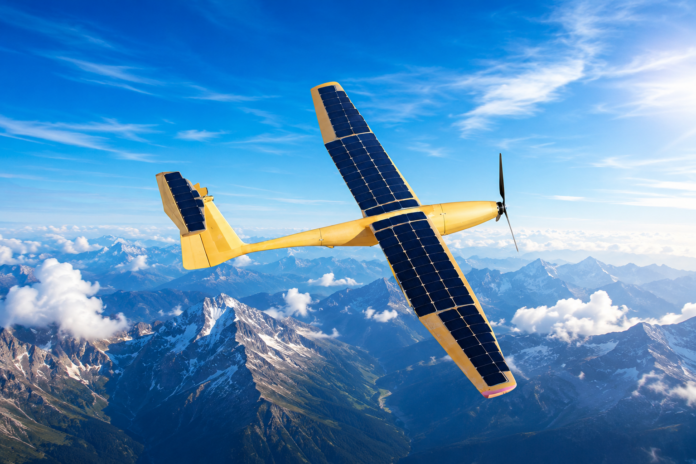

The Indian drone industry is growing rapidly as startups focus on building drones with longer flight times and better energy efficiency. In a major achievement, Maraal Aerospace Pvt Ltd successfully tested its solar-powered fixed-wing UAV, Tejasvaan.
A startup company in Noida supported by IIT Kanpur is developing high-end drones that run on solar energy that can stay airborne for long hours. These drones are used in defence, surveillance, scientific work, industrial inspections, and environmental monitoring.
The successful test flight shows the increasing capability of Indian startups in designing homegrown clean-energy aviation technologies that can support extended-duration missions.
Designed for Long-Endurance Aerial Operations
Tejasvaan is a fixed-wing unmanned aircraft with integrated photovoltaic solar panels that generate power during flight. Unlike conventional battery-powered drones that require frequent recharging or replacing of batteries, the UAV constantly recharges its onboard power by harvesting solar energy.
An airframe optimized for aerodynamics combined with electrical propulsion and intelligent energy management systems ensures maximum endurance and operational efficiency.
The company indicated that the UAV has been mainly developed for long-endurance ISR (Intelligence, Surveillance, and Reconnaissance) missions but also supports applications like mapping, disaster response, maritime monitoring, environmental protection, and precision agriculture.
Technical Specifications of Solar-Powered Tejasvaan
| Specification | Details |
|---|---|
| UAV Type | Solar-Powered Fixed-Wing UAV |
| Playload Capacity | Up to 3 kg |
| Playload Type | Optical and Infrared Cameras, Sensors |
| Range | 600+ Km |
| Flight Endurance | 12+ Hours |
| Service Ceiling | 5–6 km Above Mean Sea Level |
| Wingspan | Approximately 11 meters |
| Launch Requirement | ~200-meter runway |
| Propulsion System | Solar-Assisted Electric Propulsion |
| Flight Operations | Fully Automated |
| Energy Source | Integrated Solar Panels + Battery System |
| Primary Role | ISR, Monitoring, Mapping & Surveillance |
Advanced Engineering Features
The UAV includes a number of advanced engineering and energy optimization technologies that allow for persistent aerial operations over large geographical areas.
- High-efficiency solar energy extraction system
- Lightweight aerodynamic airframe
- Intelligent power and battery management
- Advanced propeller configuration
- Sun-tracking capability for improved solar harvesting
- Optimized component selection for endurance-focused operations
- Hybrid use of stored battery energy and gravitational potential energy management
The integration of these technologies enables the platform to stay airborne for much longer than conventional electric drones.
Applications Across Defence and Civilian Sectors
Intelligence, Surveillance and Reconnaissance (ISR)
The main role of Tejasvaan is in the surveillance and monitoring missions. Long-endurance UAVs are becoming more important for border monitoring, coastal security, observation of remote areas, and strategic reconnaissance operations.
Disaster Management and Search Operations
During floods, earthquakes and natural disasters long-endurance UAVs can provide continuous aerial imagery and situational awareness to emergency responders. Their ability to stay in the air longer enhances operational efficiency during critical rescue missions.
Environmental Monitoring
The platform can also be used for environmental and scientific missions like forest observation, wildlife tracking, pollution analysis and climate-related studies over large terrains.
Mapping and Precision Agriculture
Extended-endurance fixed-wing UAVs are more suitable for applications of agriculture and industrial surveying, such as crop analysis, irrigation planning, terrain mapping, and infrastructure inspection, due to their better coverage.
Strengthening India’s Indigenous UAV Ecosystem
The success of the trial of Tejasvaan is a sign of the increasing momentum in India’s clean-energy aviation and unmanned systems industry. Solar-assisted UAVs are being considered as the next generation of sustainable aerial platforms worldwide, which can reduce operational costs and logistical dependency.
The development underscores the significance of deep-tech startups in India’s aerospace ecosystem, driving indigenous innovation and decreasing dependence on imported drone technologies. It is also consistent with the broader national agenda of self-reliance in defence and advanced aviation systems.
In the coming years, operational endurance will be one of the defining factors in next-generation UAV development, and solar-powered platforms such as Tejasvaan could play a critical role in providing persistent aerial coverage for civilian and strategic applications.
With the successful completion of flight trials, Maraal Aerospace Pvt Ltd is placing itself among the emerging innovators who are shaping the future of sustainable unmanned aviation in India.
The article is based on information available from Maraal Aerospace and IIT Kanpur websites, along with publicly available news sources. The content is shared only for general information and educational purposes. Specifications and features may change over time.