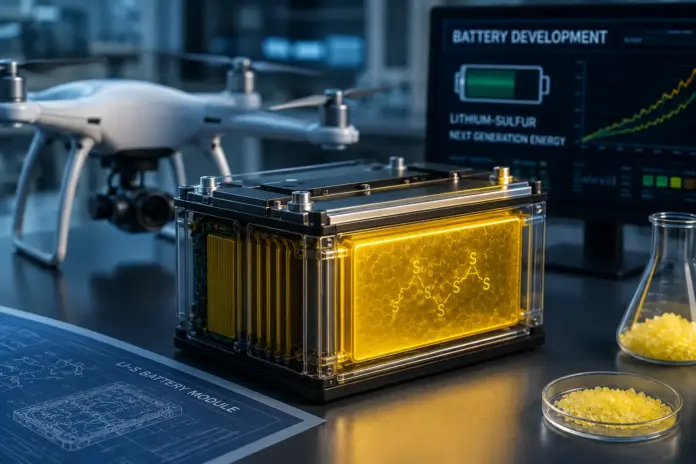

Researchers in China have developed an advanced lithium-sulfur battery technology that can enhance the flying time and efficiency of drones. According to research published in the journal Advanced Science, a team of scientists from Tsinghua SIGS has created a molecular-level solution for addressing one of the key problems in lithium-sulfur battery technology.
This discovery, recently reported in the scientific journal Nature, might open up new possibilities for designing batteries not just for drones but also for upcoming low-altitude aircraft technology.
Why Do Current Drone Batteries Have Limitations?
Most of the drones used commercially today are powered by lithium-ion batteries. These batteries are popular and reliable but are running up against practical energy density limits. Standard lithium-ion drone batteries typically have a maximum energy density of less than 300 watt-hours per kilogram, which limits flight time, payload capacity, and range.
These limitations cause range anxiety among drone users since the drones do not stay in the air long enough to perform activities such as deliveries or emergencies.
Why Do Lithium-Sulfur Batteries Matter?
Lithium-sulfur batteries have long been seen as a promising next-generation alternative because sulfur is cheap and abundant and can store much more energy than conventional lithium-ion materials.
However, the technology has had problems with stability. During charging and discharging, sulfur forms soluble intermediate compounds that move around inside of the battery. This movement impedes electrochemical reactions and causes energy loss and long-term battery performance degradation.
The New Molecular Solution
To address this problem, the Tsinghua research team introduced what they call a “premediator” for sulfur electrochemistry.
“Think of it as a special additive that sleeps inside the battery until it is needed. When the sulfur reaction starts, the additive wakes up right where the action is and begins to work,” explained Zhou Guangmin to Xinhua News.
The researchers also redesigned the internal molecular reaction network, cutting the internal resistance of the battery by about 75 percent over traditional lithium-sulfur battery designs.
Impressive Test Results
Laboratory testing results were very positive. The new lithium-sulfur battery was able to keep stable performance for about 800 charge-discharge cycles while keeping almost 82 percent of its original capacity.
More impressively, the researchers were able to develop a working prototype pouch cell that has an energy density of 549 watt-hours per kilogram, which is almost double the energy density of many off-the-shelf drone batteries today.
What This Means for Drones
“For drones, this matters a lot. Higher energy density means longer flight times, bigger payloads, and more working range. A delivery drone could fly farther to drop off packages. A power line inspection drone could cover more towers in one go. A search-and-rescue drone could stay in the air longer when every minute counts,” said Zhou.
Future Applications Beyond Drones
The research team believes their molecular design strategy can also be applied to other battery technologies like lithium-metal batteries, flow batteries, and even direct battery recycling systems.
If this new invention is successfully commercialized, it could help develop lighter, longer-lasting, and more efficient energy storage systems across a range of industries.
Chinese scientists developed a new lithium-sulfur battery technology, a major breakthrough for drone power systems. The breakthrough could allow drones to fly farther, carry heavier payloads and operate more efficiently than ever before by solving long-standing efficiency and stability challenges. Commercial deployment may take time, but the research demonstrates the growing potential for next-generation battery technologies for the future of aviation and energy storage.
The article is based on reports and research summaries available in the public domain published by news agencies and science sources. Performance figures and commercial readiness are subject to change through further technology testing and development.