
Table of Contents
What is the Draft Civil Drone (Promotion and Regulation) Bill?
You are a drone pilot in India. You purchase a new drone, register it, know how to fly it, and go out to capture an image using your new toy. But then one question always lingers around:
“What is the drone legislation going to be in the future?”
Here comes the draft civil drone bill to play its role.
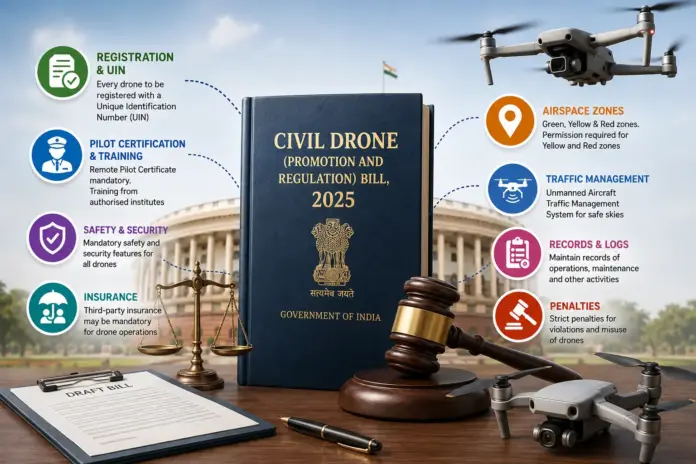
A draft civil drone bill was introduced by the Ministry of Civil Aviation through a circular dated 16 September 2025 requesting public comment on the Draft Civil Drone (Promotion and Regulation) Bill, 2025. The consultation draft was available for public input till 30 September 2025.
Therefore, the first thing that needs to be kept in mind is that the document provided below is just a draft and cannot be seen as a final piece of legislation right away.
The Draft Civil Drone Bill seeks to establish a legal framework for the promotion and regulation of unmanned aircraft systems in India.
Why was the Civil Drone Bill Required?
The drone industry in India is expanding rapidly.
Use cases for drones include:
- Photography & Videography
- Surveying and Mapping
- Agriculture
- Inspection of infrastructure
- Delivery services
- Industry-specific operations
- Research & Development
- Government use
As the number of drones flying increases, there is a requirement for regulations on who can control a drone, which drones can be allowed to be sold, how they can fly, and what happens in case of any accidents.
The draft civil drone (promotion and regulation) bill aims to bring many of these aspects under one law.
In simpler terms, the objective of the draft law is
Promotion of the drone industry while making the operation safer & more regulated.
To whom will the Civil Drone Bill apply?
The proposed bill has a wide ambit. It would apply to individuals or entities that undertake any of the following activities:
- Owning drones
- Operating drones
- Manufacturing drones
- Designing and development of drones
- Importing and exporting drones
- Selling and transferring drones
- Leasing drones
- Maintenance of drones
- Drone training services
It would apply to drones operating within or over India.
However, the proposed bill does not apply to drone systems owned by military, naval, Air Force, Central Armed Police Forces and other union armed forces. Drones having an all-up weight of more than 500 kg shall not come within the purview of this bill and would be regulated under the Bharatiya Vayuyan Adhiniyam, 2024, and its rules.
Civil Drone Bill Draft and DGCA
A very important aspect of this is the involvement of the Directorate General of Civil Aviation (DGCA).
According to the draft bill, DGCA shall become the principal regulatory agency for civil drones.
Some of its key duties will be safety regulation, regulatory duties, and supervisory roles regarding standards.
Hence, for a regular drone user, the basic idea is:
DGCA will continue playing an important role in regulating civil drones.
This draft bill has given the Central Government the power to issue regulations concerning drone classification and types of operations.
Registration, Certification and Pilot Requirements
Drone Registration and UIN
Now suppose you go and buy yourself a new drone.
As per the Bill, you can’t just go and buy it and start operating your drone.
The drone will have to be registered and then given a Unique Identification Number (UIN).
The bill suggests that drones should not be sold, bought, or transferred unless they have been duly registered and provided with a UIN.
Therefore, registration becomes an important element of the proposed civil drone bill.
The simple message for the drone owners can be put in one line:
Register the drone → Get the UIN → Maintain the records → Operate as per rules.
Type Certificate for Drones
The proposed draft civil drone promotion and regulations bill also focuses on the drone itself.
A drone generally cannot be manufactured, assembled, sold, or transferred unless it has the required type certificate, unless an exemption applies.
The proposal also says drones must have prescribed mandatory safety and security features.
These features cannot simply be removed, modified, or tampered with after being incorporated into the approved design.
In simple language:
The drone must meet the required safety standards before it enters normal operation.
Remote Pilot Certificate and Training
Now consider the person who will fly the drone using a controller.
The proposed civil drone bill states that an individual shall not fly an unmanned aircraft system without holding a valid Remote Pilot Certificate issued by the DGCA or an authorized officer in the prescribed manner.
Training has also been covered in this regard.
Only authorized entities can offer training for remote pilots, and the necessary training requirements have been laid down by the DGCA or an authorized officer.
Thus, the essence of the matter is:
Approved drone + registered drone + qualified pilot = safe drone flying.
The Possibility of Drone Insurance
The next important issue in the draft of civil drone legislation is the issue of insurance.
According to the proposal, a drone can only be operated when there is a third-party insurance policy taken out on the drone, which should meet the specifications of the Central Government. In addition, there may be exemptions for some categories of drones from the Government.
There is also an established instrument for compensation in cases of accidents.
The amount of compensation for death from a drone accident is ₹2.5 lakh and ₹1 lakh for grievous hurt, according to the proposal.
What About the Green, Yellow, and Red Zones?
This could be the most exciting part for drone pilots looking for drone rules in 2025.
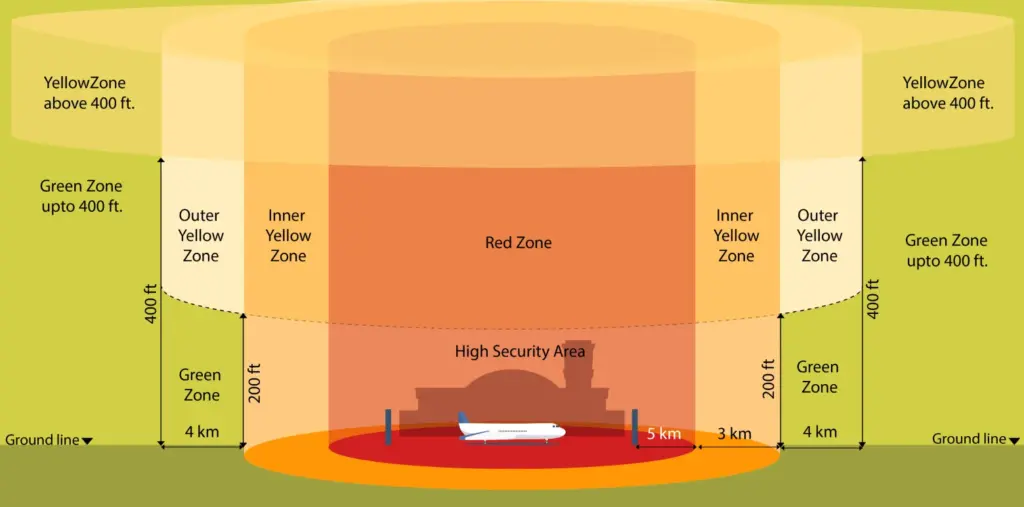
Under the proposed framework, the drone airspace shall be classified as follows:
What is Green Zone?
This will be mostly the airspace in which the operation of drones could be allowed subject to the rules.
What is Yellow Zone?
Operations of drones in yellow zones shall need prior approval of the concerned air traffic control authority.
What is Red Zone?
Operations of drones in red zones shall require prior approval from the Central Government as well as the red zone creating authority.
In case an area is subjected to restrictions by both the red and yellow zones, then both the approvals shall be required. The operator shall have to go through the rules of restriction before starting any flight.
An online map of Indian airspace classified as red, yellow, and green with a horizontal resolution of 10 meters or less is also to be made under the proposal.
Drone Rules 2025 and Temporary Restrictions
What happens in case of an emergency situation?
According to the draft, the Government and certain authorities can create a temporary red zone in case there is an immediate need to prohibit drone activities in that specific place.
The temporary restrictions may be significant while dealing with situations where there is a need to ban the flight of drones immediately.
The draft bill on civil drones also provides temporary restrictions on the operations of drones as per the requirement.
Drone Traffic Management
As the number of drones flying in the air increases, just the knowledge of where red, yellow, and green zones are located may not suffice anymore.
The draft bill on civil drone promotion and regulation has provisions for what is known as a UAS Traffic Management System.
This system can be developed by the Airports Authority of India or any other authorized agency for drone operations and impose traffic management conditions.
In simple terms:
More drones in the sky will require better traffic management.
What Can Be Carried Using Drones?
The proposal is quite clear about prohibited carriage as well.
The draft civil drone bill notes that specific categories of weapons, ammunition, explosives, and military materiel cannot be carried using drones without the required written authorization.
Also, it limits the carrying of prohibited cargo and hazardous cargo unless the flight complies with the relevant criteria.
Above all, a drone must not be used as a weapon to commit any crime.
Document Your Drone Records
This is yet another useful piece of advice for professionals operating drones.
The proposed draft civil drone law mandates the maintenance of records related to:
- Manufacturing
- Ownership
- Transfer
- Operating
- Maintenance
These documents may need to be produced before the DGCA, law enforcement, or any other authorized government department, as required.
For commercial drone companies, good documentation will be all the more important.
What Happens When Rules Are Broken?
There are provisions for penalties under the proposed civil drone bill.
For instance, failing to obey a lawful instruction and hindering an authorized official could be penalized through the imposition of a fine or imprisonment. False provision of information and deliberate omission of required information can also be met with penalties.
Violations related to the registration, manufacture, safety features, pilot license and training, and type certification could attract imprisonment up to a year, a fine of up to ₹1 lakh, or both, depending on the provisions of the proposal.
Flying in restricted red and yellow zones without the required authorization would be met with harsher penalties of up to three years in prison, a fine of up to ₹1 lakh, or both.
Implications for Drone Pilots
If you are a hobbyist, photographer, surveyor, drone manufacturer, or even a company that operates drones, the following questions are the implications of the proposed civil drone bill:
- Will your drone require registration and issuance of a UIN?
- Will your drone require certification or an exemption?
- Safety and security features should be maintained at all times.
- Do you have a Remote Pilot Certificate?
- Your training will be done by authorized organizations only.
- Insurance from third parties might be needed.
- Pre-flight airspace checks should be conducted.
- Drone operations can be banned in red and yellow zones.
- Logs and records of drones need to be kept.
- Violations lead to penalties or imprisonment.
How Are the Existing Drone Rules Affected?
One of the key questions for individuals looking for drone rules in 2025 is about how the transition to the new rules will take place.
According to the Bill, Drone Rules, 2021, as well as Drone (Amendment) Rules, 2022 and 2023, will stand repealed upon making appropriate rules under the proposed Act. All the existing actions, approvals, certificates, permissions, and other matters shall remain effective where such are not inconsistent with the proposed framework.
It would thus be more appropriate not to assume that the term “drone rules 2025” implies an entirely separate rulebook.
The uploaded document is the Draft Civil Drone (Promotion and Regulation) Bill, 2025.
The Big Picture
The backstory of the civil drone draft legislation is actually quite straightforward.
India wants to see drones flourish.
However, as more and more drones take flight, the Government wishes to have tighter control over the following:
Safety + Security + Registration + Pilots + Airspace + Insurance + Accountability.
The civil drone development and regulation draft bill aims to put all this into one legislative package where the Government and DGCA will get the authority to make the relevant detailed legislation.
This means additional responsibilities for drone operators and companies but a clear legal framework nonetheless.
Final Takeaway
Draft civil drone law needs to be seen as a framework for the coming era of civil drones in India.
It is not just an effort to restrict drones.
It is an effort to put in place a system where drones can be produced, registered, flown, piloted, insured, and maintained according to certain rules and guidelines.
If you are keeping track of drone laws in 2025, drone regulation, or the future of the drone industry in India, then this draft needs to be kept on your radar.
And for all you operators, producers, or drone service providers out there, here is the bottom line:
Know your drone. Know your pilot license requirements. Know your airspace.
Important Observation
This article provides an easy-to-understand summary of the consultation draft of 16 September 2025. The circular by the ministry sought comments from the public and the industry; therefore, the provisions discussed above are the proposed provisions, not necessarily the existing ones.