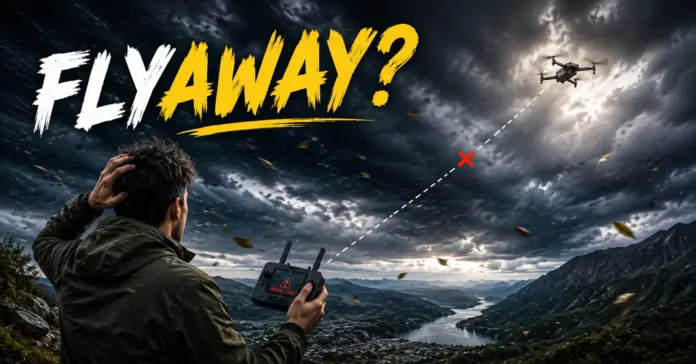

Imagine yourself on a construction site early in the morning. You are 500 meters away from your drone, which is diligently taking pictures that you will use for your orthomosaic map. The weather is favorable, everything is going well, and then…
Suddenly, you lose visual contact.
However, you understand that your drone is still safely in the air. Your controller shows live footage, the signal from GPS is good, and everything seems fine.
Still, according to regulations, you must maintain Visual Line of Sight (VLOS). Without being able to see your drone, you start losing your sense of security.
Is the drone getting closer to power lines?
Are there birds nearby?
Has an unexpected person entered the area?
Is there another plane coming in?
Such situations occur more often than many drone pilots think.
To your surprise, you do not need another expensive drone.
All you need is the best binoculars for drones.
Table of Contents
Have You Ever Lost Track of Your Drone When You Needed It Most?
While cameras get better every year, binoculars will always be among the most important accessories for professional drone pilots, surveyors, photographers, inspectors, and map makers.
In this article, we’ll show you why binoculars are absolutely essential, how to pick the right pair, and the best binoculars for drones.
Why Binoculars Are Important for Drone Piloting
Most novices think that the drone camera is sufficient.
But experts will tell you that it’s not.
The live camera feed only reveals what the drone sees.
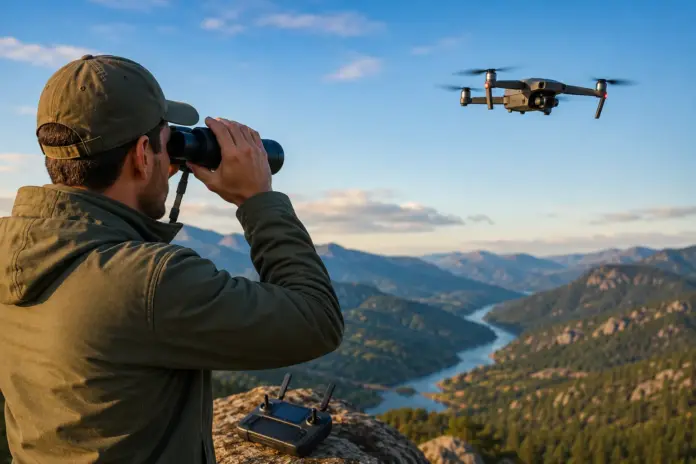
Binoculars enable the operator to see the drone, other objects around, wild animals, air traffic, and any change in weather that is not reflected in the pilot controller display.
They offer an additional sense of situational awareness that greatly increases the safety of flight operations.
Professionals conducting aerial surveys hardly start their mission without scanning the area using binoculars.
Advantages of Using Binoculars in a Drone Survey
Maintain Visual Line of Sight (VLOS)
There are many aviation regulatory bodies that mandate the pilots maintain VLOS with the drone.
Using binoculars helps to easily spot the drone from far distances while it is flying above the forest, farmlands, mountain ranges, rivers, or even industrial complexes.
Enhance Mission Safety
There are many things that may pose risks to the drone, from power transmission lines to cranes and communication towers.
Binoculars are essential for spotting such things before they become an issue.
Keep Eye on Wildlife
Bird strikes are one of the most common reasons behind drone damage.
Big birds like eagles, kites, hawks, and crows come close to the drones suddenly.
With binoculars, pilots can see their activities either before flying or when in flight.
Improved Construction Site Monitoring
Construction site monitoring varies day by day.
The workers, cars, cranes, scaffolds, and heavy machinery keep moving within the construction site.
The binoculars assist the surveyors in keeping track of the dynamic conditions at the construction site without moving into dangerous areas.
Improve Aerial Photography Planning
Professional photographers do not start off immediately.
First, they observe:
- Lighting conditions
- Ridges of mountains
- Movement of clouds
- Reflections
- Animals
- Humans
- Objects within the foreground
This observation is what distinguishes a common photograph from an excellent aerial photograph.
Faster Roof and Infrastructure Inspection
Prior to approaching buildings, operators can conduct an inspection on the following:
- Missing roof tiles
- Solar panels
- Communication towers
- Wind turbines
- Chimneys
- Bridges
- Power poles
This will help identify the safest flight route possible without wasting any flight time.
Increase Mapping Accuracy
Surveyors devote substantial efforts to choosing the following:
- Ground Control Points
- Take-off Points
- Landing Sites
- Checkpoints
- Observation Points
Binoculars make this task easier, resulting in improved efficiency and accuracy.
Applications of Binoculars in Drone Operations
Binoculars are valuable across many industries, including:
- Land Surveying
- Photogrammetry
- Construction Monitoring
- Mining Surveys
- Agriculture
- Forest Monitoring
- Wildlife Research
- Infrastructure Inspection
- Railway Inspection
- Pipeline Monitoring
- Solar Farm Inspection
- Wind Turbine Inspection
- Disaster Response
- Search and Rescue
- Real Estate Photography
- Event Coverage
How to Choose the best Binoculars for Drones
Choosing the best binoculars for drones comes down to choosing magnification, brightness, comfort, and durability.
Magnification
8× and 10× magnification are considered best for drone usage. With higher magnification, the field of view decreases, and holding becomes less stable.
Objective Lens Size
Large objective lenses (about 42 mm) collect more light, thus making images brighter during dawn, dusk, or cloudy weather.
Field of View
A wide field of view allows you to locate and track the movement of the drone better than narrow field of view.
Image Quality
Search for:
- Fully multi-coated lenses
- Phase-corrected prisms
- High-contrast optics
- Good edge-to-edge sharpness
This will help you get rid of glare and see clearly.
Weather Resistance
Make sure your binoculars are:
- Waterproof
- Fog-proof
- Nitrogen-purged
- Rubber-armored
They are necessary for outdoor surveying under any weather changes.
Weight and Comfort
As drone missions can be very long, you need lightweight binoculars with comfortable handles and adjustable eye cups.
Top 5 Best Binoculars for Drone Survey
1. Nikon Monarch M5 8×42
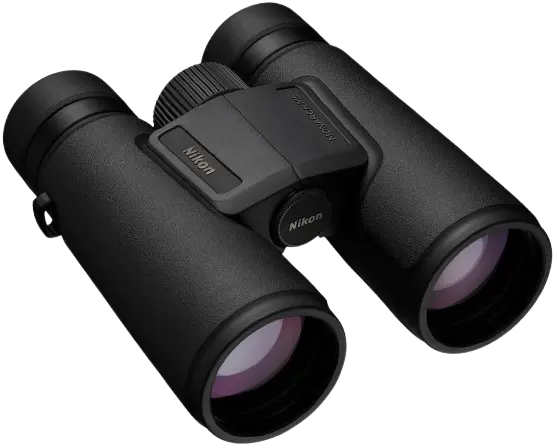
For those who have difficulties keeping their drone in sight on longer flights, the Nikon Monarch M5 8×42 will do wonders. With its stable, bright, and crystal-clear optics, it will make tracking the drone much easier and detecting any obstacle much faster. Its lightness and weather resistance also make it convenient to use during long surveys.
Features Preferred by Drone Pilots
- ED glass ensures excellent resolution with sharp images
- Bright sight, even when viewing in low light
- Field of view is wide, making it easier to track drones
- Compact and comfortable to carry
- Waterproof and fogproof for outdoor usage
- Strong rubber coating on body provides a firm grip
- Focusing is smooth and quick
- Perfect for drones surveys and aerial photography
Ideal for: Professional surveyors, mapping specialists, and aerial photographers.
2. Vortex Diamondback HD 10×42
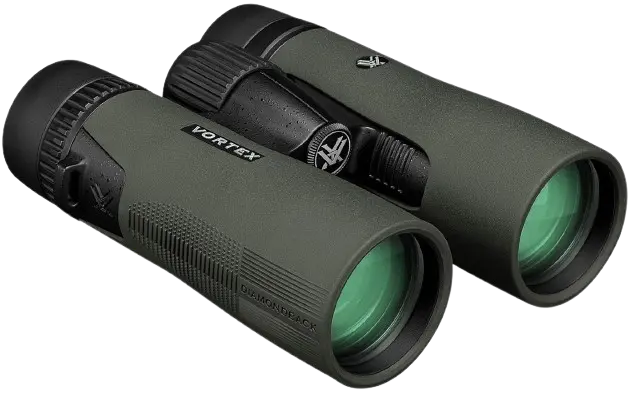
For those who experience difficulty keeping a drone in sight under the harsh rays of sunlight or at a long distance from the observer, the Vortex Diamondback HD 8×42 will help with its wide range of vision and crystal-clear view. The HD optics eliminate any image blur, while the durable and waterproof design makes it an ideal companion for drone surveys and other related activities.
Features Preferred by Drone Pilots
- HD optics create sharp and clear images.
- Wide field of view helps in tracking the drone.
- Sharp and bright image under any lighting condition.
- Waterproof and fogproof design for all-weather use.
- Durable and rubber-armored body design.
- Lightweight body that is comfortable for long surveys.
- Elegant focus wheel that allows focusing accurately.
Ideal for: Construction surveys, inspections, and general drone operations.
3. Bushnell PowerView 2 10×42 Binoculars
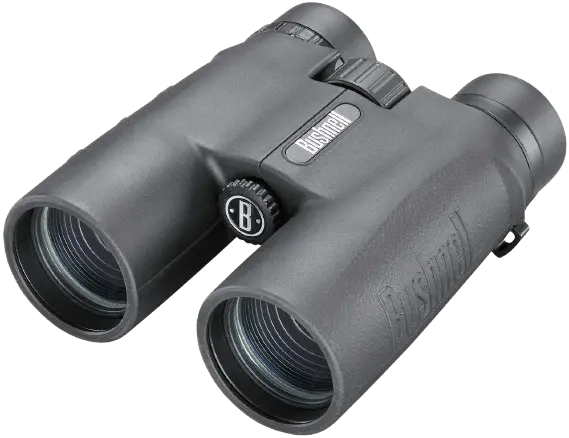
If you require an inexpensive pair of binoculars for operating drones, then this model will come in handy. It allows you to locate your drone from afar, observe the survey site, and detect obstacles prior to launching your drone. 10× magnification will give you a closer look at the object that you want to see, whether this is for inspection, construction site work, or simply drone photography.
Features Preferred by Drone Pilots
- 10× magnification for improved visibility.
- Bright and clear optics for everyday use outdoors.
- Lightweight construction for easy handling.
- Strong body made of durable aluminum alloy.
- Convenient center focus knob.
- Rubber eyepiece grip for secure hold on the binoculars.
- Inexpensive choice for novice and intermediate drone pilots.
- Good choice for drone surveys, inspections, wildlife observation, and outdoor photography.
Ideal for: Infrastructure inspection and long-range drone monitoring.
4. Celestron Nature DX ED 8×42
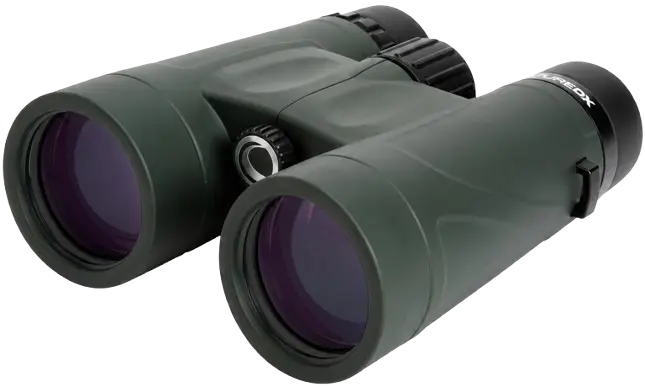
For those who would like to have a dependable binocular without having to spend lots of money, the Celestron Nature DX 8×42 is highly recommended. This binocular will help you to keep an eye on your drone, examine distant objects, and search the area to be surveyed using a bright and clear image.
Features Preferred by Drone Pilots
- 8x power allows you to see a clear picture.
- Optics are bright and sharp for outdoor viewing.
- Wide field of view for convenient observation.
- Waterproof and fogproof binoculars for outdoor usage.
- Lightweight binocular suitable for long-time surveying flights.
- Comfortable focus wheel.
- Rubber armored body providing a comfortable grip.
Ideal for: New drone pilots, students, and hobbyists.
5. TSO Polar HD 10×50 Binoculars
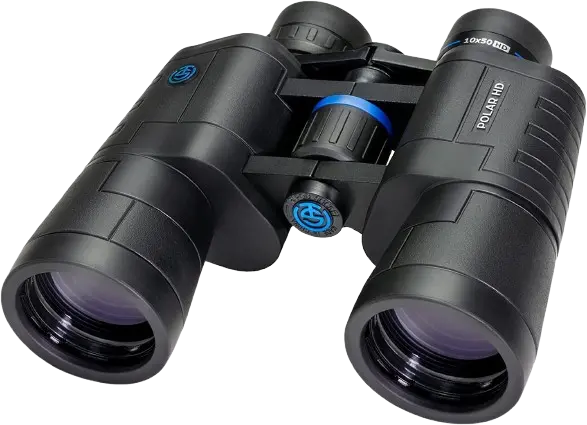
For those who want to examine remote buildings or watch their drones through open areas, this set of 20×50 powerful binoculars will enable you to see more clearly than regular binoculars. It can be used to inspect towers, roofs, transmission wires, or construction sites prior to launching your drone. The high 20× magnification makes this device unsuitable for tracking your drone in real-time.
Features Preferred by Drone Pilots
- 20× magnification for viewing distant objects.
- 50 mm objective lenses ensure clear and bright images.
- Perfect for inspections and site evaluation.
- Waterproof and rainproof for outdoor activities.
- Rubberized body that provides reliable grip.
- Adjustable focus for sharp vision.
- Good choice for drone inspections, wildlife watching, hiking, and surveillance.
- Budget-friendly choice for those who require distance viewing.
Ideal for: small businesses, new drone pilots, students, and hobbyists.
Advice on Using Binoculars for Drone Operations
- Conduct surveying of the survey area before flying.
- Employ binoculars during gaps in flights instead of constantly using them during active piloting.
- Be aware of your environment all the time.
- Collaborate with a visual observer for complicated operations.
- Clean lenses frequently for better visibility.
- Keep your binoculars in a case when not in use.
Conclusion
Drone technology has developed incredibly, yet visual observation remains one of the key obligations of any pilot.
High-quality binoculars will help you be more secure, comply with regulations, plan your flights better, and get more accurate results from your surveys and photos. Regardless of whether you are creating maps for farmlands, inspecting some infrastructure, controlling construction, or taking artistic pictures of the landscape, binoculars will add to your peace of mind.
It is a good idea to choose the best binoculars for drone surveys.
Frequently Asked Questions (FAQ)
Do drone pilots really need binoculars?
Yes. Binoculars enhance visual awareness, spot obstructions, track animals, and analyze distant locations before and during flights.
What magnification is best for drone surveys?
An 8× or 10× magnification offers the best balance between image stability, field of view, and detail.
Are binoculars useful for drone photography?
Absolutely, binoculars can be used to evaluate lighting conditions, obstacles, and composition prior to sending the drone into flight.
Can binoculars replace the drone camera?
No, the binoculars are helpful alongside the drone camera, providing the user with a broad overview of the environment around.
Are waterproof binoculars necessary?
Yes, since the outdoor drone operation involves exposure to dust, moisture, varying temperatures, etc.
Which binocular size is best for drone operators?
The 8×42 configuration is widely considered the best all-around choice, offering bright images, a wide field of view, and comfortable handling for extended missions.