
In the world of drones, camera quality is often the thing that gets the most attention. However, one of the most important innovations behind the modern drone’s performance is the transmission system that connects the aircraft to the pilot. DJI’s OcuSync technology has changed the game of drone communication, providing long-range transmission, low latency, HD video feeds, and reliable connectivity in challenging environments.
OcuSync debuted in 2016 with the DJI Mavic Pro and has seen several generations since then, becoming the backbone of many DJI consumer, professional, and enterprise drones. OcuSync is driving safe, responsive, and immersive drone operations, whether for aerial photography and filmmaking, surveying, or inspections.
In this article, we’ll go through everything you need to know about DJI OcuSync — how it works, how it’s evolved, the biggest advantages, how it compares to other transmission systems, and what’s in store for this game-changing tech.
Table of Contents
What Is DJI OcuSync?
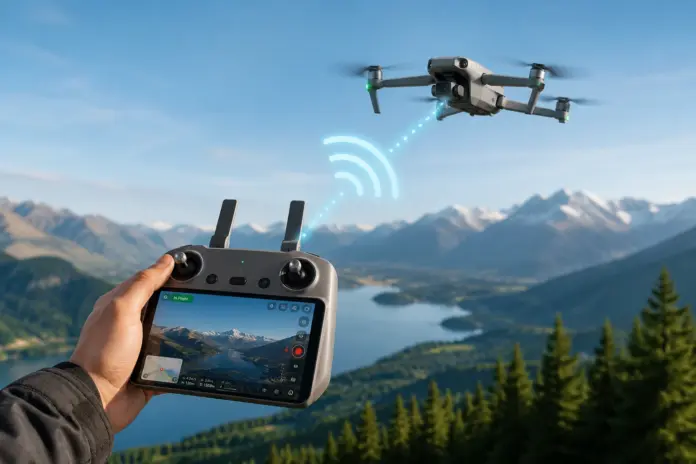
DJI OcuSync is a proprietary wireless transmission technology developed by DJI to enable communication between a drone and its controller.
Unlike conventional Wi-Fi-based systems, OcuSync combines multiple communication channels into a single digital transmission link. This covers:
- Flight control signals
- Live video transmission
- Telemetry data
- Camera controls
- Intelligent flight information
The result is a highly efficient communication system that offers better range, lower latency, and improved reliability over traditional drone transmission methods.
OcuSync is a dedicated digital road that creates a fast, reliable link between the drone and pilot, ensuring commands, video, and data travel back and forth.
Why DJI Developed OcuSync
Prior to OcuSync, DJI relied mainly on Wi-Fi and Lightbridge. Both systems worked well for their time, but they also had limitations.
Challenges with Wi-Fi-Based Systems
Many of the first consumer drones used Wi-Fi to communicate. Wi-Fi was cheap but had a few drawbacks:
- Limited range of transmission
- Susceptible to interference
- Higher latency
- Frequent signal loss
- Reduced reliability in urban/cities areas
These problems became more acute as drones became more capable and users demanded longer-range flights and better video quality.
The Need for a Better Solution
DJI aimed to develop a transmission system that would offer the following:
- Extended transmission range
- Lower latency
- Better resistance to interference
- Enhanced video transmission
- Energy-efficient
The result was OcuSync, a technology developed specifically for drone communications, not adapted from existing consumer wireless standards.
How DJI OcuSync Works
OcuSync primarily uses the 2.4 GHz and 5.8 GHz frequency bands. It does not rely on a single channel but constantly scans the available frequencies and automatically selects the best path for transmission.
Adaptive Frequency Switching
OcuSync’s dynamic frequency switching is one of its key features.
The system always checks:
- Strength of signal
- Radio disruption
- Conditions of environment
- Traffic congestion
OcuSync is capable of automatically switching frequencies when interference is detected without interrupting communication.
This is especially helpful in cities where Wi-Fi networks, mobile devices, and other radio systems all compete for bandwidth.
Low Latency Performance
Latency is the time between the action being performed and the pilot seeing the result on the screen.
OcuSync greatly lowered the latency compared to previous systems.
The benefits of low latency include:
- More accurate control
- Improved FPV experiences
- Enhanced tracking performance
- Safer flight
For drone racers, FPV fans, and professional pilots, low latency can greatly improve the accuracy and responsiveness of flying.
HD Video Transmission
Another big plus with OcuSync is the ability to transmit HD video in real-time.
OcuSync (varies by version) supports the following:
- 720p live video stream
- 1080P HD transmission
- High-bitrate video streams
- Smooth real-time monitoring
This means that pilots can see exactly what the camera sees, which makes framing and composition much easier.
Evolution of OcuSync Technology
Since its launch, DJI has been consistently improving OcuSync.
1. OcuSync 1.0
OcuSync 1.0, which was launched with the DJI Mavic Pro, and it was a massive upgrade over Wi-Fi transmission systems.
- Transmission range of up to 7 km
- 720p video stream
- Low-latency operation
- Dual-band communications
This system helped make the Mavic Pro one of the most innovative consumer drones of its time.
2. OcuSync 2.0
DJI launched OcuSync 2.0 in the DJI Mavic 2 Pro, DJI Mavic 2 Zoom, and DJI Mini 2 drones.
Major improvements included:
- Auto-switching between two frequencies
- Enhanced blocking ability
- 1080p video streaming
- Longer transmission range
OcuSync 2.0 has quickly become one of the most reliable drone transmission systems on the market.
3. The O3 and O3+
The next generation brought significant improvements that were found in drones like the DJI Air 2S, DJI Mavic 3, and DJI Mini 3 Pro.
The major improvements in O3 and O3+ are
- Improved signal stability
- Extended Range
- More detailed video feeds
- Better urban performance
- Better penetration through interference-heavy environments.
The O3+ became especially popular among professional filmmakers and commercial operators.
4. The O4 Transmission Technology
DJI’s new generation transmission system (commonly called O4) powers drones such as the DJI Air 3, DJI Air 3S, and DJI Mini 4 Pro.
Major improvements include:
- Transmission distance up to 20 km (FCC conditions)
- Anti-jamming algorithm enhancement
- Improved image transfer quality
- Improved signal penetration
- Better reliability
O4 is the most sophisticated consumer transmission technology from DJI to date.
OcuSync vs Wi-Fi
| Feature | OcuSync | Standard Wi-Fi |
|---|---|---|
| Range | Excellent | Limited |
| Latency | Low | Higher |
| Signal Stability | Very High | Moderate |
| Interference Resistance | Excellent | Limited |
| HD Video Quality | Excellent | Good |
| Professional Applications | Yes | Limited |
OcuSync vs Lightbridge
| Feature | OcuSync | Lightbridge |
|---|---|---|
| Portability | Compact | Larger |
| Range | Longer | Long |
| Latency | Lower | Slightly Higher |
| Interference Handling | Excellent | Excellent |
| Ease of Integration | Better | More Complex |
| Consumer Use | Ideal | Less Common |
Major Advantages of OcuSync
Superior Signal Reliability
OcuSync performs well in environments where interference would be a challenge for traditional systems.
Long-Range Transmission
Many DJI drones with OcuSync can maintain long-range connections at several kilometers.
Enhanced Safety
Reliable communication. You won’t lose signal unexpectedly.
Better FPV Experience
High-quality, low-latency video adds to the immersive flight experience.
Multi-Device Compatibility
- DJI Goggles
- Multiple controllers
- Professional monitoring systems
Future-Proof Architecture
DJI continues to enhance OcuSync to ensure its compatibility with future drone tech.
Limitations of OcuSync
Real-World Range Varies
Advertised ranges are based on ideal conditions. Actual results will be affected by:
- Terrain
- Buildings
- Trees
- Weather
- Radio interference
Regional Restrictions
Transmission power differs between the following:
- FCC regions
- CE regions
- Other regulatory jurisdictions
Proprietary Ecosystem
OcuSync is specifically designed for DJI products and has limited compatibility with third-party hardware.
The Future of DJI OcuSync
As drone technology keeps evolving, OcuSync is likely to get even smarter. Possible future developments include:
- AI-aided signal optimization
- Improved obstacle-aware transmission
- Better multi-drone communications
- Lower latency video stream
- Integration with next-generation wireless technology
Such developments will further strengthen DJI’s position as a leader in drone communication systems.
Conclusion
DJI OcuSync has revolutionized communication between the drone and the pilot, with a dependable, long-range, low-latency transmission in a small and effective system. OcuSync has been the standard for drone connectivity from the beginning, from the DJI Mavic Pro to the latest O4 technology in today’s flagship drones.
Whether an aerial photographer, filmmaker, surveyor, inspector, or recreational pilot, OcuSync gives you the dependable connection to fly safely and successfully. As DJI continues to innovate, OcuSync will be one of the most important technologies powering the future of unmanned aviation.
Frequently Asked Questions (FAQs)
1. What is DJI OcuSync?
DJI OcuSync is DJI’s proprietary wireless transmission system, enabling a drone and its remote controller to communicate with each other transmitting video, telemetry, and flight control data.
2. Is OcuSync better than Wi-Fi?
Yes. OcuSync usually provides a longer range, lower latency, greater interference resistance and more reliable HD video transmission than standard Wi-Fi systems.
3. Which DJI drones use OcuSync?
Popular DJI drones using OcuSync include the Mavic Pro, Mavic 2 Pro, Air 2S, Mavic 3, Mini 3 Pro, Air 3, and Mini 4 Pro.
4. What is the maximum range of OcuSync?
OcuSync can achieve transmission distances from 7 km to 20 km under ideal FCC conditions, depending on the version.
5. What is the difference between OcuSync 2.0, O3, and O4?
Each new generation adds transmission range, interference resistance, video quality and signal stability. It’s the most advanced version available on consumer DJI drones to date.
6. Can OcuSync work with DJI Goggles?
Yes. Many OcuSync-enabled drones are compatible with DJI Goggles for an immersive first-person-view (FPV) flying experience.
7. Does weather affect OcuSync performance?
Yes. Heavy rain and fog, obstacles, and strong electromagnetic interference can reduce the quality of transmission and effective range.
This article is for informational and educational purposes only. Depending on the drone model, the firmware version, the operating environment, and the local regulations, the specifications, transmission ranges, features, and performance of DJI OcuSync may differ. The actual quality of transmission may be affected by interference, obstacles, weather conditions, and other external factors. All trademarks, product names, and logos appearing herein are the property of their respective owners. Always check local laws and regulations, aviation authorities, and manufacturers’ instructions before flying any unmanned aircraft.