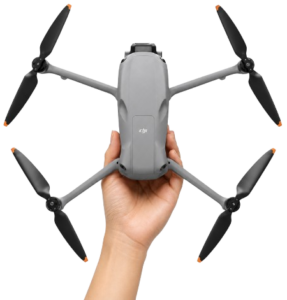
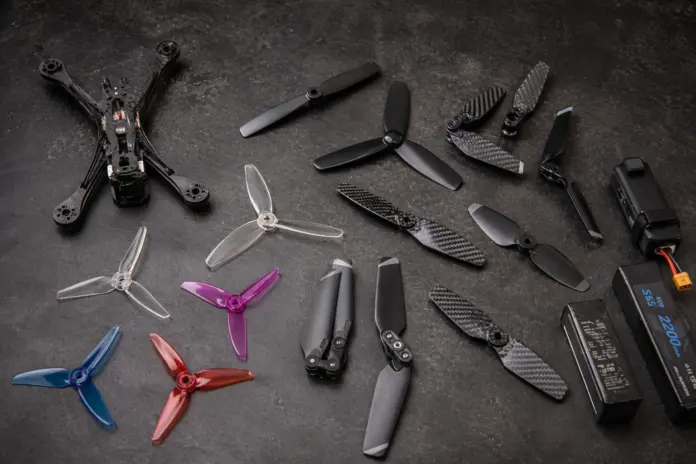

The real performance of a drone is not determined by its motors or flight controller; it is determined by the thin spinning blades that turn electricity into controlled thrust: the propellers.
The propellers of drones are of extreme importance when it comes to modern unmanned aerial systems. Despite their simple appearance, these components are products of advanced engineering, which includes aerodynamics, materials science, and dynamics of rotation.
Regardless of whether you are flying your drone for taking aerial photos, mapping terrains, or even agricultural spraying, your choice of propellers will affect certain performance indicators, which include flight time, payload weight, noise, and maneuverability.
This blog article explains everything about types of drone propellers, from how they work and what parameters they have to how they can be classified and what criteria should be used to choose a proper propeller.
“The right propeller transforms an average drone into a high-performance aerial machine.“
Table of Contents
Common Parameters of Drone Propellers
The blades are long, curved arms that spin around to interact with the air. Their unique shape (called an airfoil) lets them push air down, which gives them the lift (or thrust) they need to fly. The hub is the main part of the propeller, which will connect the blades to the motor shaft. The hub itself doesn’t create lift, but it is an important safety feature because it needs to be strong enough to keep the blades in place while they spin quickly.
How to Read Propeller Size Notation?
People usually use a standard format that combines the diameter and pitch values to identify drone propellers. A propeller with a 10-inch diameter and a 4.5-inch pitch, for example, would be called “10×4.5.”
This notation makes it easy to quickly figure out how well a propeller will work in general. But it shouldn’t be the only thing that affects behavior. Other things, like blade geometry, material composition, and manufacturing tolerances, also have a big impact on performance.
Basic Factors That Affect How Well Drone Propellers Work
A drone propeller may look like a simple part that spins, but its performance is very sensitive to even small changes in its shape and the materials it is made of. Even small changes in size can have a big effect on thrust generation, efficiency, and flight stability. Because of this, it’s important to have a clear understanding of the main propeller parameters before looking at different propeller configurations or choosing parts for a UAV system.
Key Parameters and Their Effect:
| Parameter | Definition | Impact on Flight | General Trend |
| Diameter | Total span of rotating disc | Control thrust & aerodynamic efficiency | Larger size → lower RPM, improved efficiency |
| Pitch | Axial movement per rotation | Determines speed capability & load handling | Higher pitch → greater speed, higher load |
| Blade Count | Number of blades contributing to thrust | Affects responsiveness & thrust continuity | More blades → quicker response and increased drag |
| Material | Substance used to manufacture the propeller | Impacts rigidity & deformation resistance | Higher stiffness → stable aerodynamic performance |
How Does the Diameter of the Propeller Affect the Flight Dynamics?
The diameter of a propeller determines how big the circle is that its blades make when they spin. This parameter is very important because it affects how much air is displaced and, in turn, how much thrust can be generated.
Propellers with larger diameters move more air, which lets them make enough thrust even when they are spinning slowly. This makes flying smoother and uses less energy, which is especially helpful for applications that involve heavy loads or long periods of hovering. On the other hand, smaller diameter propellers need to spin faster to get the same amount of thrust, which makes them better for flight conditions that require quick reactions and agility.
The Importance of Pitch in Propeller Performance
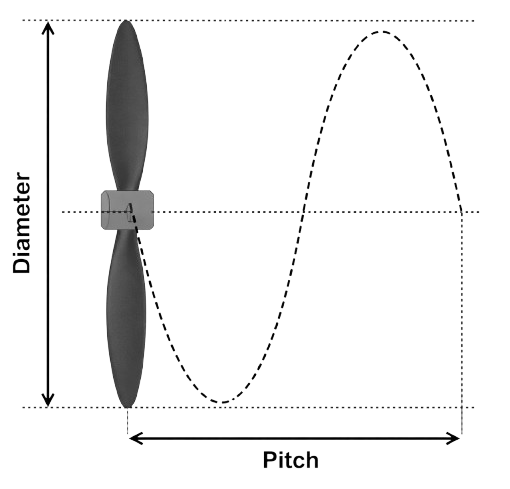
If there were no aerodynamic losses, pitch would be the imaginary distance a propeller would move forward in one rotation. It is an important factor that determines how fast the propeller moves air.
A higher pitch means that the blades are angled to push more air back with each turn, which makes the forward speed and load-carrying ability better. But this also means that more power and torque are needed. On the other hand, lower-pitch propellers make thrust generation more controlled and gradual, which makes them great for stable hovering and precise maneuvering.
Influence of Blade Count on Propeller Thrust
The number of blades on a propeller is called the blade count. More blades can make more thrust and smoother airflow, which makes it easier to lift heavier loads and cuts down on vibration. But adding more blades can also make things less efficient and use more power. Fewer blades are usually better because they respond faster, which makes them good for fast and agile flying. in flight
The Importance of Materials in Drone Propellers
The material that makes up a drone propeller has a big effect on how well it flies. The amount that the blades bend or change shape while spinning depends on the materials used, which in turn affects thrust stability and overall control. The choice of material is often more closely related to how and where the drone will be used than the number of blades. Choosing the right material helps make sure that certain uses will work better, last longer, and be more reliable.
Types of Drone Propellers Based on Blade Count.
Drone propeller blades can be single, two-blade, three-blade, and multi-blade, each of which has different thrust and performance characteristics. Fewer blades mean higher efficiency and longer flight time, but more blades mean greater thrust and improved stability.
| Blade Count | Thrust | Efficiency | Power Draw | Application |
| Single Blade | Low thrust | Very high (least drag) | Very low | No practical use, Research purpose only |
| Two Blades (Double) | Moderate & Balanced thrust | High | Low | General-purpose drones |
| Three Blades (Triple) | High thrust, quick response | Moderate | Medium | Racing, FPV, and freestyle drones |
| Four or Multi-Blade | Very high Thrust, smooth response | Lower (high drag) | High to Very high | Heavy lift, industrial drones |
Single-blade Drone Propeller
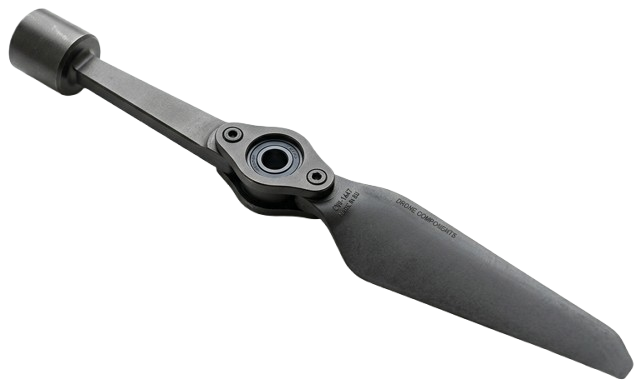
A single-blade propeller is a less common and niche design, mostly used on experimental and research drones. One aerodynamic blade is coupled with a counterweight to maintain the balanced rotation.
Their blade area is smaller, so they produce relatively low thrust. But they are very aerodynamically efficient and have very little drag. These propellers perform well at higher RPMs but need to be balanced carefully to avoid vibration problems. Power consumption is usually low, so they are better suited to efficiency testing than to practical load carrying. Single-blade propellers are not common for regular commercial and hobby drones, but they are widely used for aerodynamic research and prototype development in real applications.
Two-blade Drone Propeller

The most common type of propellers found on drones are two-bladed (or double-bladed) propellers, as they provide a good balance of performance characteristics. They consist of two opposing blades that provide stable thrust with little aerodynamic interference.
These propellers are usually characterized by moderate thrust output, high efficiency, and low current consumption, and therefore they are suitable for longer flight durations. They are simple, reducing drag and allowing motors to run efficiently at moderate RPMs. Two-blade props come in many sizes defined by their diameter and pitch (i.e., 10×4.5), which means they can be used on many different drone platforms. They are commonly used in aerial photography, surveying, and general-purpose drones where efficiency and stable flight are more important than maximum thrust.
Three-bladed Drone Propeller
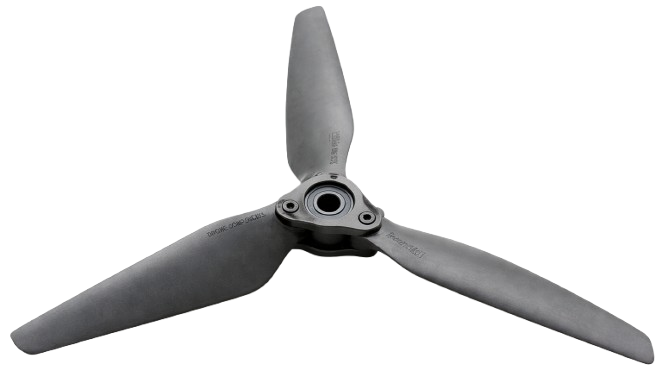
Three-blade (triple-blade) propellers are designed to provide higher thrust and improved responsiveness over two-blade configurations. The extra blade provides them with more surface area interacting with air, which gives them more thrust output and a smoother power delivery.
However, the penalty is a moderate loss of aerodynamic efficiency and a higher current consumption due to the increased drag. These propellers generally run a little lower RPM for the same thrust but require more power from the motor. Three-blade props are commonly used on racing and freestyle drones, as they require fast throttle response and precise control. They are also favored in applications with increased stability during rapid maneuvers.
Four or Multi-blade Propellers
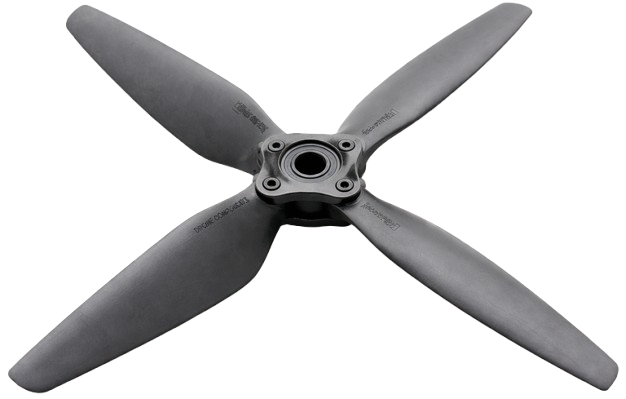
Multi-bladed propellers, generally four blades or more, are made to produce the maximum amount of thrust and to give an even flow of air while in operation. More blades means more air moved at every revolution, which leads to an extremely high lifting capacity and stable thrust output.
But such a configuration has a high aerodynamic drag and, therefore, low efficiency and high current consumption. These propellers usually run at a lower RPM , but need stronger motors and power systems to maintain their performance . Multi-blade designs, often found on heavy-lift drones, film platforms, and industrial UAVs, prioritize payload capacity and flight stability over endurance. Their capacity to generate constant thrust makes them perfect for applications with cameras, sensors, or delivery systems.
Types of Drone Propellers Based on Material
Drone propellers are made from a variety of materials, including plastic, carbon fiber, and wood. Plastic propellers are cheap and flexible; carbon fiber and wood offer more strength, durability, and performance.
| Material | Rigidity | Deformation at high RPM | Cost | Application |
| Plastic/Nylon | Low to moderate | moderate | Cheap | Entry-level & Lightweight drones |
| Carbon fiber | High | Very low | Expensive | Industrial & heaby lift drones |
| Composite materials | Moderate to high | low | Affordable | Photography & commercial drones |
Plastic or Nylon Drone Propellers
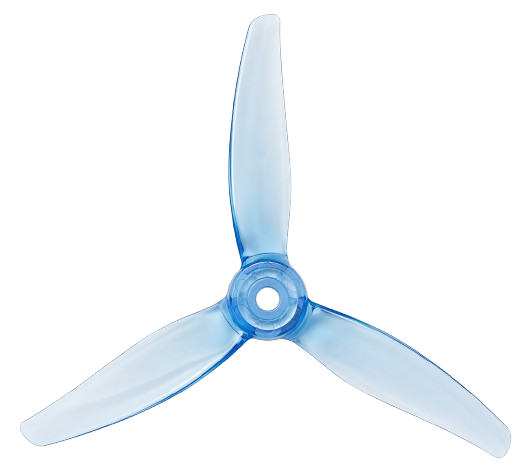
Nylon or plastic propellers are common in beginner and consumer-grade drones because of their affordability and easy fabrication process. These propellers are relatively light and flexible, thus able to withstand the impact from crashes.
However, their flexibility means that they deform easily at high rotation speeds, resulting in inefficient generation of thrust forces. The use of such propellers is therefore best suited for applications where performance is not a primary requirement.
Carbon Fiber Drone Propellers
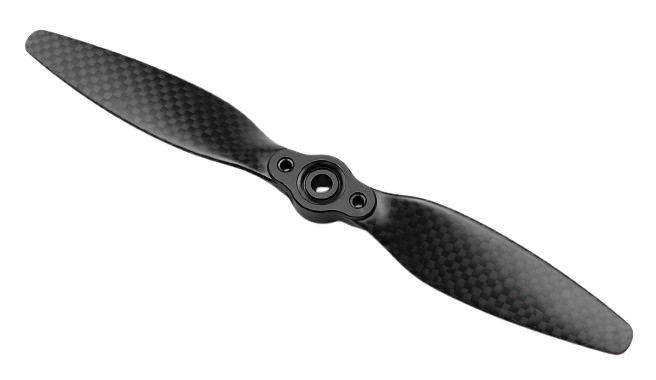
Carbon fiber propellers are recognized for their strength and stiffness. This enables them to remain rigid even when operated at high RPMs. As a result, they deliver consistent performance and efficient aerodynamics.
Because of their stiffness, carbon fiber propellers offer improved stability during flight and accurate control. Nonetheless, they are costlier compared to other materials used in making propellers and may shatter easily if struck abruptly.
Composite Material Drone Propellers
The composite propellers comprise a combination of materials such as plastics and fiber reinforcement for achieving a balance in performance. The stiff nature makes the composite propellers better compared to other plastic propellers; they are relatively inexpensive when compared with carbon-fiber propellers. The composite propellers have moderate load-carrying capability, and therefore, they are mostly used in the mid- to high-range drone photography application.
Types of Drone Propellers Based on Structure
Fixed Drone Propellers
The fixed type of propeller is made up of blades that do not move at all. The blades are always in one place; therefore, they cannot fold. This type of propeller has a simple design, and hence, it is reliable and durable. It performs consistently in flight. It is, however, bigger and bulky.
Foldable Propellers
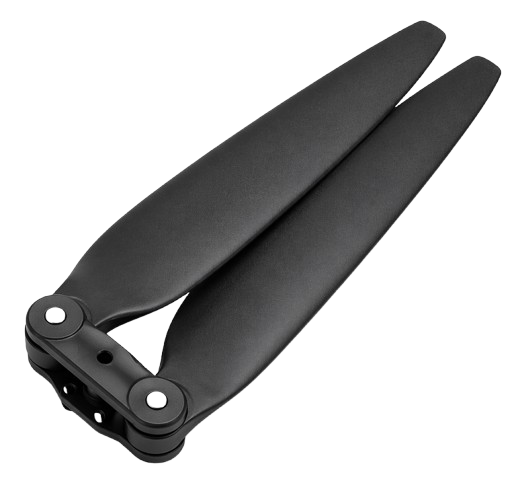
The blades on a foldable propeller have the ability to collapse onto themselves when the drone is not in use. The blades unfold when the motor comes on, since they are rotated at the same time. This feature helps make it easy for the drone to be transported and stored.
Self-Tightening Propellers
The self-locking propellers ensure that they fix themselves on the rotor shaft while rotating. The spinning motor enables the propeller to tighten itself automatically, making it impossible for it to loosen. Self-locking propellers make it safer and easier to install, besides helping maintain steady operation while flying.
CW vs CCW Drone Propellers
The CW and CCW propellers spin in opposite directions to each other. They are employed in pairs in order to counterbalance each other’s forces that are generated due to the motors’ activity. This is necessary for preventing the drone from spinning randomly. The manipulation with their speed allows turning the drone and keeping it in balance.
Effect of Drone Propellers Types on Performance
Thrust Production Influence
Different types of propellers greatly influence how much thrust can be generated by the drones. The greater number of blades and the larger diameters of the propellers mean that more volume of air can be displaced to create more thrust. They are therefore ideal for applications that require heavy lifting or have high industrial uses.
Effect on Flight Efficiency
The design of the propeller is vital when considering flight efficiency and the utilization of the battery. Propellers with two blades tend to be more efficient since they produce less drag, thus enabling the drone to fly for extended periods. On the other hand, propellers with multiple blades are power-hungry but produce greater thrust.
Impact on Stability and Control
The nature of the propeller has a direct impact on the stability and control of drones during flight. The more blades a propeller has, the smoother and constant its flow is, and thus better control and stability can be achieved. However, a smaller number of blades means faster acceleration and maneuverability.
Effect of the Material on Performance
The type of material that is used for construction determines the stiffness of the propeller as well as the capability of the propeller to retain its shape when subjected to any external force. Stiff materials such as carbon fiber guarantee uniform aerodynamics performance and control at higher speeds.
Noise and Operations Issues
There are other variables that affect noise levels as well. More blades on the propeller produce more noise because they disturb the airflow, but fewer blades produce less noise. This is an issue for tasks such as shooting from the air or operating in cities, where low noise is preferable.
How to Pick the Proper Drone Propellers?
Define the Operational Requirement
The first step towards choosing an appropriate drone propeller is identifying what the application will be. The different types of drones perform specific tasks, which require unique features. For instance, a drone flying at slow speeds requires propellers that produce more thrust.
Match Propeller with Motor Specifications
An essential factor that needs to be considered in engineering is the match-up between the propeller and the motor. There are factors like motor KV, torque, and optimal propeller size that need to match each other. If there is a mismatch between the propeller and motor, there will be increased power consumption.
Evaluation of Diameter and Pitch
Diameter and pitch affect the force generated and behavior during flight. A large diameter produces high force at low RPMs and can be used for lifting purposes or hovering. A pitch with high values allows faster forward speeds but increases the burden on the drive system.
Take Into Account Material Properties
The choice of material is responsible for the stiffness and reliability of an aircraft as well as its aerodynamic stability when spinning at high velocities. For carbon fiber materials, it is possible to ensure higher rigidity, but cheaper alternatives like plastics or nylons can be more flexible and resistant to impacts.
Evaluate Blade Number and Efficiency
The blade count will affect both the amount of thrust created and energy expenditure. Propellers with two blades tend to be more efficient as well as better suited for prolonged flights, while those with multiple blades have more thrust but use more energy.
Consideration of Environmental and Operating Conditions
Apart from internal factors like speed, diameter, pitch, and blade number, external environmental factors also have an effect on propeller performance. Windy areas require propellers that are high-thrust and stable in their operations. Moreover, issues of noise reduction or easy transportation may dictate propeller choice.
Frequently Asked Questions (FAQs)
1. What are the main types of drone propellers?
Drone propellers are mainly classified based on blade count (single, two, three, or multi-blade), material (plastic, carbon fiber, or composite), and structural design (fixed, folding, or self-tightening).
2. How does blade count affect drone performance?
Blade count influences thrust and efficiency; fewer blades offer better efficiency and longer flight time, while more blades provide higher thrust and improved control.
3. What is the difference between propeller diameter and pitch?
Diameter determines how much air is moved and affects thrust, while pitch defines how aggressively the propeller pushes air, influencing speed and load capacity.
4. Which propeller material is best for drones?
Carbon fiber is best for high performance and stability, plastic is suitable for beginners due to its low cost and flexibility, and composite materials offer a balanced option.
5. Why are CW and CCW propellers used together?
They are used in pairs to balance motor torque, ensuring stable flight and enabling controlled yaw movement.
6. What are folding propellers used for?
Folding propellers are used in portable drones and VTOL systems, as they save space and improve transport convenience.
7. How do I choose the right propeller for my drone?
Choose a propeller based on your application, motor compatibility, required thrust, efficiency, material, and environmental conditions to ensure optimal performance.
Conclusion
However, drone propellers are much more complicated than mere rotating structures since they are actually the primary aerodynamic mechanism dictating the overall performance of the drone. Diameter, blade configuration, and materials all play an important role in thrust generation and the efficiency of the operation.
Having information about various types of propellers helps pilots and engineers to design their aircraft based on the task at hand.